
Category Archives: World Changing Ideas

Project 365 – Square Foot Gardening For Food

Anyone who has ever gardened has heard the expression, “square foot gardening.”

It’s a modified version of “raised-bed intensive,” an old technique that is supposed to create a highly controlled space where dense planting produces greater yields.

Some of us (me included) have employed some of the methods to get the greatest amount of food out of the smallest patch of dirt.  And some, like the Square Foot Gardening Foundation, have taken the concept of maximum yield from small space to the nth degree.

They’re good at it too and should be.  The founder of this organization is Mel Bartholomew — PBS host, author and gardener himself.

Bartholomew has been nominated twice for inclusion Cambridge Who’s Who for this gardening method.  He simplified this gardening technique and made it easy for total beginners and seasoned gardeners to use successfully.  And his books and videos made this method of gardening readily available to anyone, anywhere.

Bartholomew could have stopped with fame and international accolades but he didn’t.  That’s why I’m writing about him.  He took his interest in  big yields from small patches and created The Square Foot Gardening Foundation.

The foundation’s purpose?  To end world hunger.

Square foot gardening is the method this group of dedicated people use to teach families how to grow healthy food and improve their diets.  The foundation also teaches classes and supports local community gardens. And it trains certified teachers who then support NGO (non-governmental) projects overseas.

The Square Foot Gardening Foundation is teaching folks to grow their own food all around the world. That’s why they are on the list of 365 organizations and the people behind them who are helping to save the world.

My thanks to Michele McCarty for suggesting this group.  Michele, who is a member of the Linked In group, Grow Girls Grow Organic,  is also training with Square Foot Gardening Foundation to become a certified teacher and she is the owner/President of Wonder Wormin Vermicomposting Systems.
Leave a comment

Filed under Gardening, Inspiring People, Life & Death, Project 365, Saving Money, World Changing Ideas

Project 365 – Saving Animals & Saving Ourselves

Let me start this post by saying, I am not a vegetarian or vegan.   I eat beef, chicken and pork.

But I don’t buy any meat at the supermarket.  All of our meat comes from two local farmers whose animals I see grazing in the fields and lazing in the sun.  Why not just swing by the store and grab that plastic wrapped pork loin or t-bone steak?

Because I know where the meat in the store came from, how the animals were raised and I cannot enjoy my meals.  Restaurants and supermarkets rely on factory farms for their meat and poultry.

You’ve probably heard the term “factory farming” before but may not  really know what it means.  Let’s just look at chickens to help give you a glimpse inside factory farming.

Try to imagine thousands and thousands of chickens crowded into one small place, each chicken getting a 6 inch by 6 inch square to live in. Shortly after hatching, chicks have the ends of their beaks cut off.  Performed without anesthesia, large scale growers say it’s to reduce injuries that result when stressed birds are driven to fighting — for space, for food, for their very lives.

A commonly-held justification for keeping and killing chickens this way is that chickens aren’t smart.  Maybe…but what about pigs?

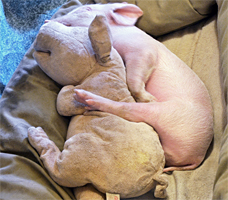
A baby piglet settles in with his friend. (Photo courtesy of Farm Sanctuary)

Recent research has shown that pigs are among the quickest  animals to learn new routines including herding sheep, opening and closing cages and playing video games with joysticks.

In fact, they are perhaps the smartest, cleanest domestic animals known – more so than cats and dogs.  And they learn as fast as chimpanzees — the animal whose genome is 98% identical to ours.

More than 100 million of these smart animals are raised in factory farms every year, confined from birth to death and subjected to intense overcrowding in every stage of their short lives, until they reach a slaughter weight of 250 pounds at 6 months old.

Animals on factory farms never get to see the sun, never graze and some, like pigs, never even get to lie down.   The “farmers” say it’s a business; people who know better say it’s abuse.  And it’s this type of abuse that Farm Sanctuary has fought against for more than 25 years.

What started in 1986 as a group of dedicated volunteers has grown to the nation’s leading farm animal protection organization but its mission has not changed.  Farm Sanctuary is committed to, “… ending cruelty to farm animals.”  This group also brings its now considerable resources to education and advocacy.

These are two tools Farm Sanctuary uses to take its message to millions of people who had no idea how cruel life for animals is on today’s industrialized farms.  Farm Sanctuary also pushes for laws and policies to prevent the unspeakable conditions these thinking, feeling animals are currently forced to endure.

How can we help?

Start by understanding the real price that cows, pigs and chickens pay on factory farms.  Stop buying meat in stores.  Find and support a local farmer, instead.  Vote with your dollars  and tell factory farmers it’s time to clean up their act.  And you’ll be helping Farm Sanctuary change the world, making it a better place for our fellow inhabitants — farm animals.

2 Comments

Filed under Education, Gardening, Healthcare, Inspiring People, Life & Death, Project 365, World Changing Ideas

Project 365 – How Worms Can Change The World

What do red worms have to do with changing the world?

Okay, they can’t stop nuclear waste, stupid politics or animal abuse.  They’re not going to march on Washington and demand a balanced budget or an end to the war in Afghanistan.

But like you and me, when they do their jobs, they make a difference in whatever little corner of the world they are set up in.  How?

Set these little wrigglers loose on household waste and stand back.  They turn into freight trains.  Just one bin and one pound of worms will turn everything from paper to food waste (no meat, dairy or fried/oily foods or glossy print papers, please) into some of the richest fertilizer around.

Now that may not sound like a big deal or a big job unless you know these numbers.

The waste created by the average American household is made up of 33% paper and almost 13% food waste.  With a simple worm bin and a pound of worms, you can turn most of that into a natural supplement for your garden, shrubs and houseplants.

Michelle McCarty is the owner and CEO of Wonder Wormin’ Vermicomposting Systems.  She says vermicomposting can transform almost half of a household’s waste and keep it out of landfills.

This California girl does workshops teaching Vermicomposting. She raises Red Wigglers and builds worm bins.  She sells them as kits to people who want to start their own worm farms at home.  And Michelle also sells worm castings (vermicast) and worm tea that she produces herself.

McCarty makes money by selling worms and bins but her business is really a labor of love.  She is a teacher.  She shares information, advice and articles to help people learn about going green and leaving a smaller footprint on our planet.

And that’s why I added her to my list of 365 people and businesses helping to change the world.

Know any other people in your town or city who are helping others?  Send me the name of the group and any info you want to share and I will do the rest.

3 Comments

Filed under Gardening, Inspiring People, Life & Death, Project 365, World Changing Ideas

Project 365 – Growing Is Good For The Soul

As an organic gardener, it’s tough for me to separate myself from the deep emotions that working with soil, in the early morning sun brings to my small corner of this vast planet.  If I were a betting woman (never started because my Dad said if you can’t afford to lose it; don’t), I would say that every gardener feels the same way.

Gardeners know that growing plants is therapeutic whether you’re growing vegetables, flowers or herbs.  At the end of a long winter, warm soil, warm sun and the wonderful, rich aroma of earth just waiting for seeds or seedlings can lift the spirits of many.

Growing is good for the soul.

What makes growing even more fulfilling is when it’s coupled with programs that bring the joy, the peace and the satisfaction of bringing seeds to life — programs like The Growing Center in Frederick, Pennsylvania.

The Growing Center offers horticultural therapy programs that  focus on youth at risk, the physically and mentally challenged and senior citizens.  Using gardening as a healing element, the Center also helps people whose lived have been disrupted by illness or injury.

Programs are designed to improve participants’ abilities to do tasks and help them cope with the changes that have occurred sometimes unexpectedly in their lives.  The Growing Center also offers horticultural stress relief workshops once a month for people who just need a break.  And what better place to get it.

The Healing Garden at the Growing Center, a four-acre bit of heaven adjacent to the greenhouses, is a riot of color and scent from spring to fall.  The gazebo offers a peaceful spot for just closing your eyes and relaxing.  The pond, benches and shaded areas add to the pleasure and peace that people who come to the Center can enjoy.

Aside from its horticultural therapy programs and The Healing Garden, The Growing Center has also developed ten acres of its land  into community gardening plots offered to anyone in the community who would like to grow vegetables for themselves.  There is only one requirement – gardeners must give any surplus to a local food bank or others in need.

No fees are charged for the horticultural therapy sessions.  Most of the funding comes from donations and from membership fees.  And the Growing Center is a mostly volunteer organization.  It grew out of the life experience of its founder and current Executive Directory, Linda M. Boyer, and her husband David who was diagnosed with a brain tumor in 1992.

Surgery left him in a wheel chair, one side of his body paralyzed.  Costs for his care drained the Boyer’s bank accounts and almost led to the loss of their farm.  Neighbors helped raise funds, saving the farm from foreclosure and their generosity led the Boyers to start this non-profit organization.  Once they started, they never slowed down or looked back.

The Boyers and their neighbors are another example of people working  every single day to help change the lives of others.


Leave a comment

Filed under Gardening, Inspiring People, Life & Death, Project 365, Religion, World Changing Ideas

Project 365 – Mosquitoes In January

It’s way too cold out right now to be thinking about mosquitoes.  Well, at least it’s too cold for most of us to even consider this summer pest.

But not for Ray Chambers.

Chambers is the co-founder of Malaria No More, a non-profit with one mission – eradicate malaria by 2015.

That’s a pretty big task especially considering that every 45 seconds, a child in Africa dies from malaria. But Chambers, who has devoted his life to this cause is working tirelessly to rid the world of this preventable and treatable disease.

If you look at the numbers, you’ll see that it won’t be easy.  Every year:

  1. 247 million people contract malaria.
  2. Close to a million of those who contract malaria die.
  3. 91% of the cases are in Africa.
  4. 85% of them are children under the age of 5.

Surprisingly, there are a number of new cases of malaria in the United States every year, virtually all of which were acquired outside of the US.  A lower risk stateside but a much higher risk for anyone traveling to countries where malaria is experiencing a resurgence.  The growing resistance to anti-malarial drugs is also a cause for concern.

Ending deaths from malaria requires an investment in prevention, diagnosis and treatment.  The arsenal of weapons used in this battle include bed nets, spraying, diagnostic tests and medicines. A vaccine is now in development to prevent malaria in the future.  All of these require financial support.

To get enough support to eradicate malaria, this modern-day plague also requires visibility.

And visibility is something Chambers is pretty good at.  He is currently the  global ambassador for Population Services International (PSI), the world’s largest distributor of anti malaria mosquito nets.

PSI credits the support of groups like Malaria No More for providing the resources needed to send out 120 million nets, nets that have saved  more than a million lives and prevented 100 million malaria cases.

Chambers is also the UN Secretary General’s Special Envoy for Malaria, another avenue for visibility. And his organization, Malaria No More, is part of the global Roll Back Malaria Partnership.

Co-founded by the World Health Organization, the Roll Back Malaria partnership offers a  global framework to implement coordinated action against malaria.

Ray Chambers is part of a partnership that’s fighting to wipe malaria off the face of our planet; he is also a man on a mission to do just that.  That’s why he is on my list of 365 people and organizations that are changing the world.

2 Comments

Filed under Inspiring People, Life & Death, Project 365, Religion, World Changing Ideas

Project 365 – Teach A Person To FIsh

What is that old saying, “Give  a man a fish and he will eat for a day. Teach a man to fish and he will eat for the rest of his life.”

I think that’s why I find what Heifer International does every day, across the globe, to be world changing.  And yes, I have written about this organization before but when there are so many lives changed, so many communities lifted out of poverty, I cannot ignore them.

Heifer International deserves all the attention it gets.  Why?

You can read all about the organization.  Or, if you’re into short stories, watch this brief video clip to find out.  (Heifer has been doing this so long and so well, it can explain how it works in exactly 1 minute.)

So, this organization doesn’t arrive with boxes of food and measuring cups.  They arrive with livestock – goats, cattle, water buffalo, chickens, ducks, even bees.  And they don’t just drop the animals off and drive away.

Heifer works with the community, creating a development plan, choosing recipients carefully and providing all the training needed including animal husbandry, water quality and ecologically sound agricultural practices.

People who receive livestock are also expected to raise crops needed to feed their animals, to become self-supporting. And all recipients become donors – passing on offspring to other members in the community or village. The objective is  to help feed hungry people but also, to create sustainable growth.  (They’ve got a short video about this, too.)

Heifer is truly teaching men and women to fish.

Started in 1939 by a relief worker named Dan West, Heifer International has helped more than 12 million families and a total of 62 million men, women and children.  One man’s simple idea –giving families a source of food rather than short-term relief — hasn’t changed since he took the first shipment of cattle to Puerto Rico in 1944.  It is alive and helping people in 128 countries around the world including the United States.

That’s why I love this organization, I support them instead of typical relief organizations and, yes, I write about them.  But they are literally changing the world.  For as little as $20.00 you can buy a flock of chicks or ducklings and start changing the world, too.

If you know any  other people in your town or city who are helping others, please send me the name of the group and any info you want to share and I will do the rest.

Leave a comment

Filed under Gifts, Inspiring People, Life & Death, Project 365, World Changing Ideas

Project 365 – Neighbors Helping Neighbors

In the heart of Oxford, Pennsylvania there is a place that offers a lifeline to people in need.

Neighborhood Services Center (NSC) is a small operation with a small staff but the service that it provides is big, especially to people living and working in this rural area and especially in the current economic times.

Founded in 1971, NSC doesn’t have counselors on staff; it doesn’t offer typical social service programs.  What NSC offers is far more valuable.  It offers connections – links between people who need services and people who provide them.

According to its website, this privately run, non-profit is still focused on its original goal of assisting people to achieve health, wholeness and stability in their lives by:

  • Establishing a link between people who want to reach out to help others.
  • Offering people with questions, problems or emergency needs a place to explore options and/or find answers.
  • Providing space for county agencies and community programs to deliver services directly to people.

People who come to NSC for help can also receive emergency assistance services like food, clothing, rent and utility assistance.

NSC relies on funding from 4 other regional agencies — United Way of Southern Chester County, Chester County’s Department of Human Services, the Health and Welfare Foundation of Southern Chester County and the Oxford Area Civic Association.  It also relies heavily on volunteers who put in thousands of hours a year to ensure help is available when and where it’s needed.

NSC is not sexy.  It’s not going to make headlines nor is it going to be featured on national television.  But it is going to continue its 40 year tradition of providing help, advice and resources to the people who live in and near its office.

From my chair, this agency and the people behind it belong on the list of 365 people who are helping to change the world.

Know any other people in your town or city who are helping others?  Send me the name of the group and any info you want to share and I will do the rest.

Leave a comment

Filed under Inspiring People, Life & Death, Project 365, World Changing Ideas

Project 365: Education At The Frontlines

Sticking with education because it is so important to our children, to our lives and to our future, there are a man and a project in Harlem that deserve to join the ranks of those who are changing the world.

Like Sal KahnGeoffrey Canada believes in the power of education so much that he has given his life to it.  Unlike Kahn, who uses the internet to reach as many people as possible, Canada’s quest is more focused and more personal.

Canada is the man behind The Harlem Children’s Zone Project (HCZ).

Founded 20 years ago as a program to address problems that poor families in this drug-riddled neighborhood were facing —  crumbling apartments, failing schools, violent crime and chronic health problems, HCZ grew into a life-changing force.

At the outset, the project centered on classroom education but Geoffrey Canada recognized early that this approach was not working. What they were teaching children inside classrooms just couldn’t counter what those same children learned about in the street, every day — drugs, shooting deaths, dire poverty.

That realization led Canada to look at the whole picture, the child within the community. It also led to expanded efforts to include after school services to kids as well as programs on parenting, early-childhood development, mental health counseling and drug and alcohol counseling for parents and care givers.

Understanding that education alone would not save these children from repeating their parents’ history, one of the  primary objectives of the overall project became “…to create a critical mass of adults around them who understand what it takes to help children succeed.”

Dubbed, “…one of the most ambitious social experiments of our time” by the New York Times, The Harlem Children’s Zone Project started with one block in that city; today it covers 100 city blocks and touches the lives of 8,000 children and 6,000 parents.

Based on HCZ’s data that show that it’s  impossible to separate education in the classroom from education in the streets, Harlem Children’s Project has also become the template for President Obama’s Promise Neighborhoods program.

Geoffrey Canada is definitely changing the world, one child at a time.

On a personal note, as someone who pays an enormous amount of school taxes, as a person who is in the process of being disenfranchised by the autonomous school board in our district, I will say here, now, that I would gladly pay my school taxes to help support a Promise Neighborhood program.

I would even pay them to support HCZ because I know that the dollars going into these programs help teach children and adults how to live better, healthier lives.  The dollars in our district seem to go to larger administration buildings and bigger salaries for the people who work in them.

By they way, if you know a group or an individual that is helping to change our world for the better, please share their story with me so I can share it with my readers.


4 Comments

Filed under Education, Gifts, Inspiring People, Project 365, World Changing Ideas

Project 365 – The Lowcountry Orphan Relief

Low Country, in South Carolina, is one of the most beautiful areas along the East coast.  It’s also a popular vacation spot with a rich history and some of the finest golf courses and resorts in the South.  It’s a place that makes you think of warm breezes and beautiful beaches.

It’s also home to a small but rapidly growing non profit that is focused on providing clothing and support to orphans – The Lowcountry Orphan Relief.

Orphans, in this country?  You don’t hear a whole lot about them, perhaps because the number of children orphaned in the United States in 2010, according to UNICEF, was  low – 2100.

That’s not a big number when compared to the more than 2 million children that are orphaned every year in Africa or the 31,000 orphaned in India last year according to UNICEF’s comprehensive report entitled The State of the World’s Children 2011.

So, why write about an organization named Lowcountry Orphan Relief (LOR)?

Simple.  This small but dedicated group of people doesn’t just help orphans; it helps abused and neglected children, too.   If you look at those numbers, you’ll understand why their work is even more important.

In 2010, there were more than 700,000 verified incidents of child abuse in this country, 85% of which involved either neglect or physical abuse.

The Lowcountry Orphan Relief is catching and caring for children in and around Charleston, as fast as they can.  Founded in 2003 by a woman whose job it was to speak for children caught in the court system, this organization provides clothing, toiletries, books and school supplies within 48 hours of a child’s removal from his or her home.

Two statistics define this mostly volunteer group that makes up Lowcountry Relief:

  1. They have clothed more than 10,000 needy children since 2008.
  2. 90% of all income given to this group is used to provide for the children’s needs.

LOR has also built libraries at emergency shelters and group homes in the tri-county area and continues to attract support of its neighbors and neighboring businesses in its quest to meet its mission statement:
…to provide services and aid to meet the meet the needs of abandoned, abused and neglected children in the Lowcountry and specifically intervene where government aid ends.

That’s why Lowcountry Orphan Relief is on my list of 365 organizations and people who are changing the world.  If you want to learn more about this wonderful organization, check out this article:  Guardian Angel.

My thanks to fellow WordPress blogger Andy who nominated Lowcountry Orphan Relief and whose posts make me grin.

If you have a group or a person who you think belongs in the list of world-changing people, please share it with me.  I will do the rest!

4 Comments

Filed under Inspiring People, Life & Death, Project 365, Religion, World Changing Ideas

Project 365 – Smile!

Maybe a smile is all you have to give but the power of that smile to lift up someone who is having a bad day or whose life is changing cannot be underestimated.  

And guess what? Smiling doesn’t just make you feel better; it makes the other person feel better, too according to researcher Ron Gutman.

Gutman says that smiling is also associated with reduced levels of stress hormones like cortisol, adrenaline, and dopamine, increased levels of mood-enhancing hormones like endorphins and lowered blood pressure.

Researchers at UC Berkeley demonstrated that smiles can yield information about the smiler including how fulfilling and long lasting their marriages would be, how highly they would score on standardized tests of well-being and general happiness, and how inspiring they would be to others.

In fact, UC Berkeley has created a new area of study centered on what it’s calling the science of happiness.

So next time you’re feeling down or a co-worker or friend is having a bad day, consider sharing your smile with someone else. It’s easy, it’s free and it’s just one way you can start changing yourself and your world.

Leave a comment

Filed under Inspiring People, Life & Death, Project 365, Religion, World Changing Ideas